
COLUMBIA, S.C. — When Knoxville, Tenn., hosted the World’s Fair in 1982, more than 90,000 people attended the opening ceremonies, including President Reagan. The six-month celebration was designed to be a cultural boom time for the city, hopefully raising it to the economic status level of nearby powerhouses Atlanta and Charlotte as well.
The fair’s tagline? “You’ve Got to Be There.”
Coca-Cola used the platform to announce Cherry Coke to the world. The NFL played an exhibition game in town, as did the NBA. Hungary sent the World’s Largest Rubik’s Cube. Touch-screens were the hottest new thing in tech (“would they last?!?”).
A mummy from Peru was unwrapped for the first time, free for fairgoers to see and examine up close. Each of the 180 nights ended with a 10-minute fireworks show over downtown.
When all was said and done, Knoxville’s 1982 World’s Fair made a total of… fifty-seven dollars.
—
On Saturday, I spent my afternoon hanging out at World’s Fair Park in downtown Nashville, where all of the absurdity I mentioned above (and more) happened nearly 40 years ago.
Frankly, I don’t know a lot about World’s Fairs. I don’t think many people my age do either. It’s kind of an antiquated concept. It made sense, say, from 1880 to 1980, that the best way to share an innovation with the world was to get a whole bunch of people together to show-and-tell our best things. Culturally speaking, the World’s Fair is how Americans learned about a lot of important stuff: bikinis, pancake mix, color TVs, etc. This is where the rubber used to meet the road for much of our modern society.
But not recently, I don’t think. Once the internet came around, we could learn about anything we wanted pretty darn quickly. And if you wanted to debut something to the world, what better way than to everyone, all at once?
So when I learned (via Google Maps) that Knoxville was home to such a storied exhibition process — perhaps the artistic and cultural equivalent of the sporting Olympic Games — I had to check it out for myself.
These days, extravagant structures designed for short-term life, like “Olympic Parks” and Super Bowl sites, are known to go kaput after a few years, if the city (and more importantly, the citizens) can’t keep a active interest in things going on there afterwards — so choosing to visit felt like I was doing my diligence in seeing Knoxville’s hard work as a city. This meant a lot to the people who lived there then now, surely.

World’s Fair Park is a dandy, comfortable public space dug out in the heart of the city, right next to a historic rail line. There’s a large field of healthy, even, satisfying grass — like a golf course fairway — and a reflection pool flanked by an amphitheater.
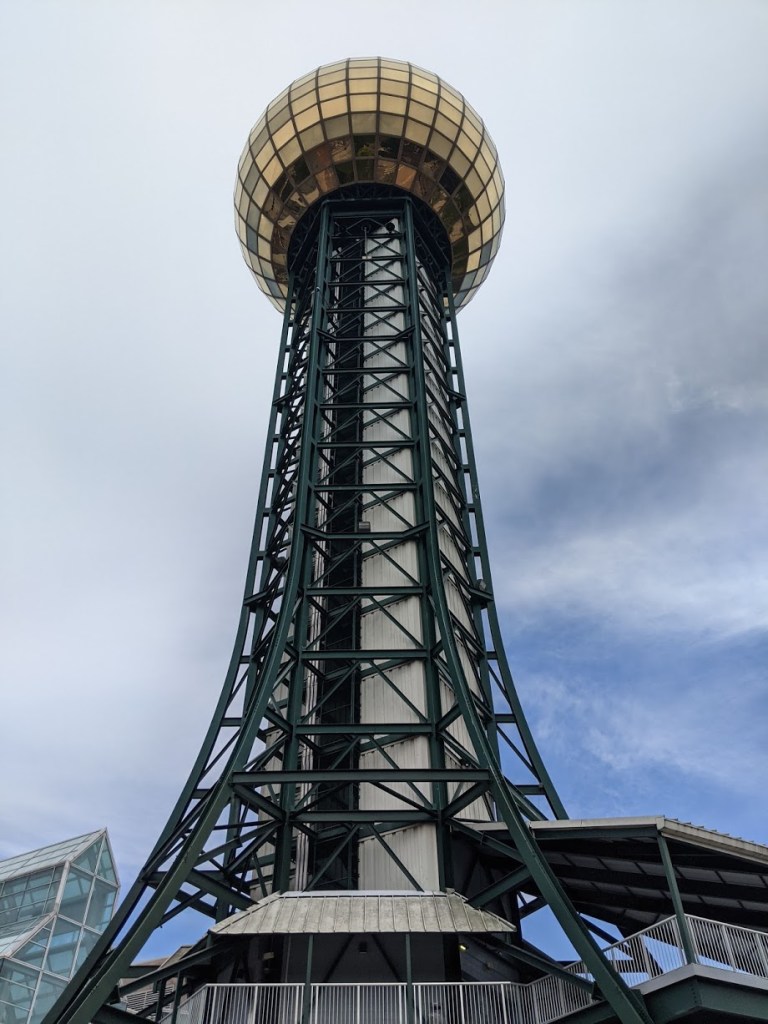
The crown jewel of it all, however, is the Sunsphere.
Again, World’s Fairs are a time when cities like to debut stunning new architecture or design, and it’s usually something that represents the city for years to come — this is the case for the Space Needle (Seattle, 1962), the Eiffel Tower (Paris, 1889), and even the concept of the Ferris Wheel (Chicago, 1893).
Thus, consider the Sunsphere as Knoxville’s contribution to this trend/tradition.
Honestly, I thought I recognized the Sunsphere from somewhere. But not this. Not Knoxville. For some reason, I thought it was a punchline somewhere. A joke.
Well, it was.
The Simpsons lampooned the Knoxville World’s Fair in a 1996 episode where Bart finds a (14-year-old) pamphlet for the (closed down; decrepit) destination. Bart and a few boys cluelessly go, and Nelson Muntz throws a rock at it when they realize their mistake — crushing their car.
Fortunately, I had a better time there than the boys from Springfield, but the Sunsphere was also closed for me (has been since COVID).
Knoxville really does have a beautiful public pedestrian space in the World’s Fair Park — a gift in itself that many cities couldn’t buy or design if they wanted to. Several families were playing in the combination flag pavilion/splash pad (as well as hosting a sun-bleached birthday for one very lucky and loved 6-year-old), where the ceremonies rang strong almost 40 years ago.
I had a good walk by myself and took some nice pictures of a genuinely bright and safe place to hang out.
—
So why is the Knoxville World’s Fair considered a failure? I didn’t see anything wrong with it (save for, you know, that embarrassing $57 profit.
I’ll show my hand here and tell you what Wikipedia says:
“Hotels and other accommodations in Knoxville were not permitted to take reservations directly. Room reservations for everything from hotels to houseboats were sold in a package with fair admission tickets through the first eleven days of the fair, and were handled by a central bureau, Knoxvisit. Its financial and administrative troubles resulted in reservations being taken over by PLM. It also struggled with the operation and filed for bankruptcy.”
But another factor was Knoxville’s reputation as a rail city, and not even the biggest economic hub in the state of Tennessee. Two years before the expo, the Wall Street Journal dissed Knoxville as “a scruffy little city,” which, of course, everyone took umbrage to locally.
While more than 11 million people came to check out Knoxville’s World’s Fair — some paying $100 for a festival pass — the city inherited a debt of $50 million, which took 25 years (see: 2007) to pay it all off.
I guess you just “had to be there.”
The Scruffy City, Reborn
Today, Knoxville claims that underhanded moniker — “The Scruffy City” — as a symbol of pride.
Perhaps proudest of them all is Scruffy City, a multi-business, single-building operation devoted to bringing good times to Knoxville, including bars, pubs, live music, and cute trinkets, right along Knoxville’s main pedestrian stretch, Market Square.
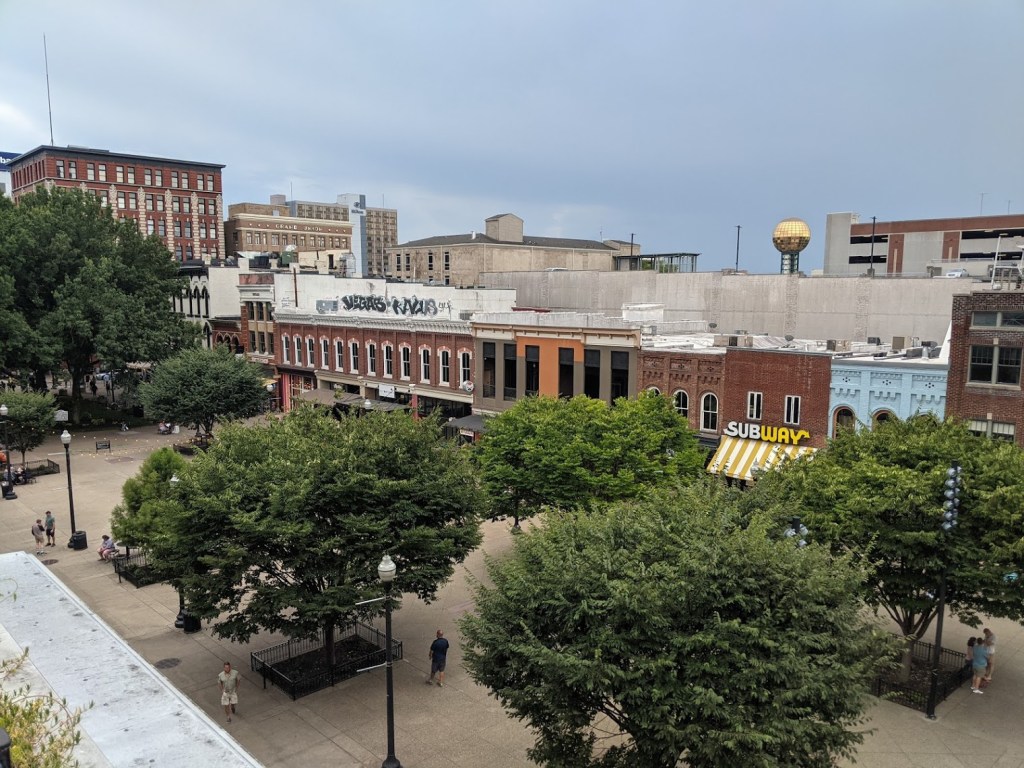
I had a limited period of time in which to see things on Saturday, so I decided to go to Scruffy’s primary establishment — appropriately called “Scruffy City Hall.”
I ended up sitting on the third-floor rooftop (if you can end up sitting on the roof anywhere, do it), under a shaded corner with a tiny blackjack table of a cabana bar.
My drinking buddy was a chill dude who wanted to be identified as “Honey Badger.”
Honey Badger’s a good dude. He loves Portland, where he worked for a bit; loves his kitchen family, as well as good food; and has a tattoo of his own graffiti art (which reads two different ways depending on how you look at it). He wore a black Colorado Buffaloes T-shirt, and he has gauged ears. He stepped away to purchase a cigarette lighter and came back with BIC’s wild turkey design, of all options, so I know he’s got a sense of humor.
I chatted with Honey Badger for a little bit — him drinking agave seltzers, me drinking hazy IPAs — about life and what we were doing. I told him I was a writing teacher on hiatus, and he expressed that I was “lifting people up,” which made me feel really good about what I do (or will do again, in about 4 weeks) with young minds.
Honey Badger, however, had a rougher string of events than my pretty career path.
He served two tours in Iraq, “when ISIS was most active.”
“Around 2014, when we just went in and cleaned up.”
I asked him if he wanted to talk about it, and he said “not really” — but that he respected me asking. We agreed that some people don’t have that grace these days. Maybe it’s just the byproduct of a 20-year-war, as of this upcoming September, but many folks don’t realize just how much trauma people like Honey Badger still live with every day.
Honey Badger told me he appreciated my company, as well as our bartender James, because we’re “real.”
“If they’re not real, they shouldn’t be in your life.”
Maybe that’s why Honey Badger, “Scruffy City,” and even Knoxville’s hit-or-miss World’s Fair attempt were so endearing to me — they’re real.
Honey Badger, if I see you again, the next drink’s on me. I hope you got the (Irish-style) Fish and Chips you were jonesing for. I’m rooting for you and your mother.
Until next time, keep it real.
-Jeff
 B-TOWN Moose