
COLUMBUS, Ohio — From the very minute I booked my stay in Charlottesville, Va., I knew exactly where I would eventually end up.
These days, the tragedy is synonymous with “Charlottesville” itself, much like “Waco” or “Oklahoma City.”
On August 12, 2017, James Fields Jr. drove his car into a crowd of people counter-protesting the “Unite the Right” white supremacist rally near Charlottesville’s historic pedestrian mall.
His 2010 Dodge Challenger rammed a mass of human flesh, tossing several dozen bodies in the air. In addition to terrorizing millions of people around the world who felt compelled to stand up for justice, he injured 35 peaceful pedestrians, and brutally murdered an innocent woman: Heather Heyer, who was hesitant to even attend the protest, but decided to join last-minute because the cause was too important to not show up for.
I don’t need to recite much further: If you’re like me, you probably saw the graphic footage of his sociopathic behavior play on news networks for days. I worked in a newsroom at the time, and the guttural visuals and sounds of the attack were permanently tattooed to my brain. An iconic photograph of the moment of collision won the Pulitzer Prize. A police crash reconstructionist estimates his car was going 23 to 28 mph when he drove it into the crowd, scooping up the mass of broken humanity.
Heyer, a restaurant server and paralegal who lived alone, died of blunt-force trauma to the chest. She was 32.
Since 2017, Charlottesville has renamed 4th Street (where the attack occurred) “Heather Heyer Way.” And although four years has passed, the road is still a testament to Heyer’s mission, as well as the credo of the 35 injured protestors and everyone else present that day.
My buddy Cory and I agreed to check out the block and pay tribute to history. I can’t speak for him, but the concept of visiting morbid places in American history is very powerful to me. I’ve been to the Washington, D.C., Hilton hotel where President Reagan was shot in March 1981, and I also made a point while I was in Dallas and Memphis to see where JFK and Dr. Martin Luther King were assassinated, respectively. To see the place where an unspeakable tragedy occurred, to be in that same spot and know it could have happened right as I’m seeing it, right there, right now, is an unfathomably intense experience that reminds me of why we learn history in the first place: to learn and adjust our behaviors as a society, to prevent these things from happening again.
Admittedly, this grim hobby is not for everyone, but it does a lot for me in terms of internalizing our essence as humanity: I would much rather find the spot in Indianapolis where visiting New York senator Robert F. Kennedy (standing on a flatbed truck) delivered the news of Dr. King’s assassination to an African-American community at 17th and Broadway on April 4, 1968, than eat a fancy steak or shrimp cocktail at St. Elmo’s. Seeing the former does more for me in terms of acknowledging Indianapolis’ contribution to history. (But it’s not a contest. Engage yourself in local culture however you’d like.)
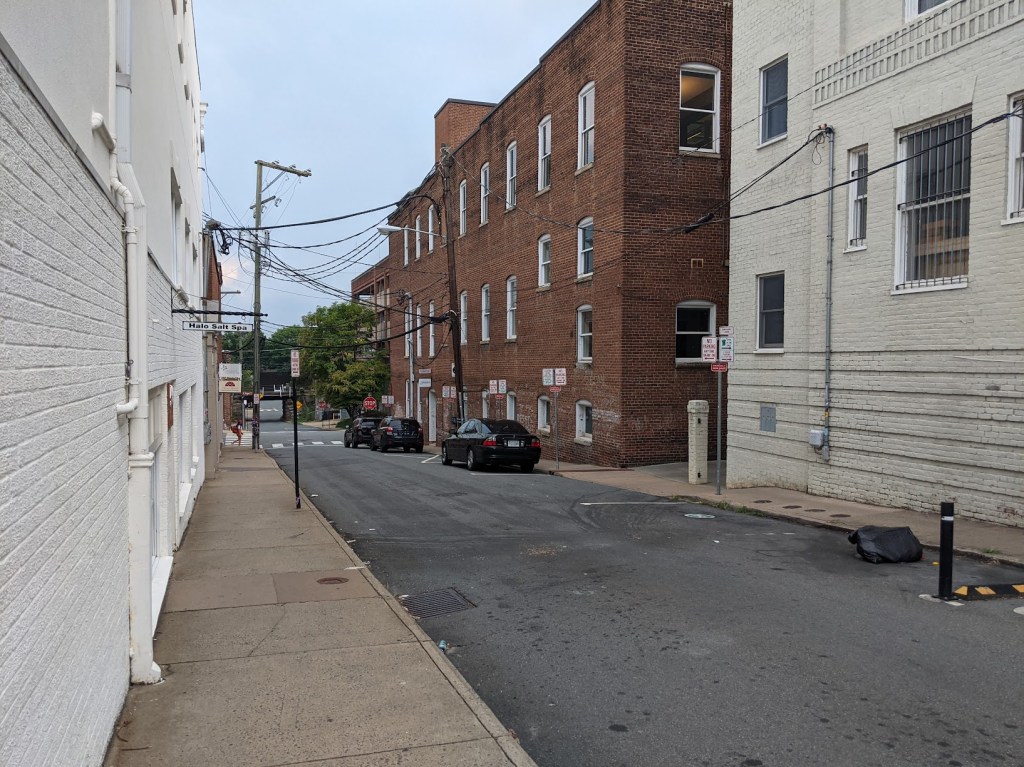
When Cory and I stepped onto Heather Heyer Way, we were stricken with a heavy silence. Just like it felt when I saw the “X” in the turnpike at Dallas’ Daley Plaza, marking the exact spot in the road where JFK was shot (as well as the platform marking where the Zapruder Film was shot), our presence from the exact vantage point of the media artifacts we saw of the Charlottesville attack immediately illustrated the depth and horror of the situation.
It was real. It happened. And we were looking right at it.
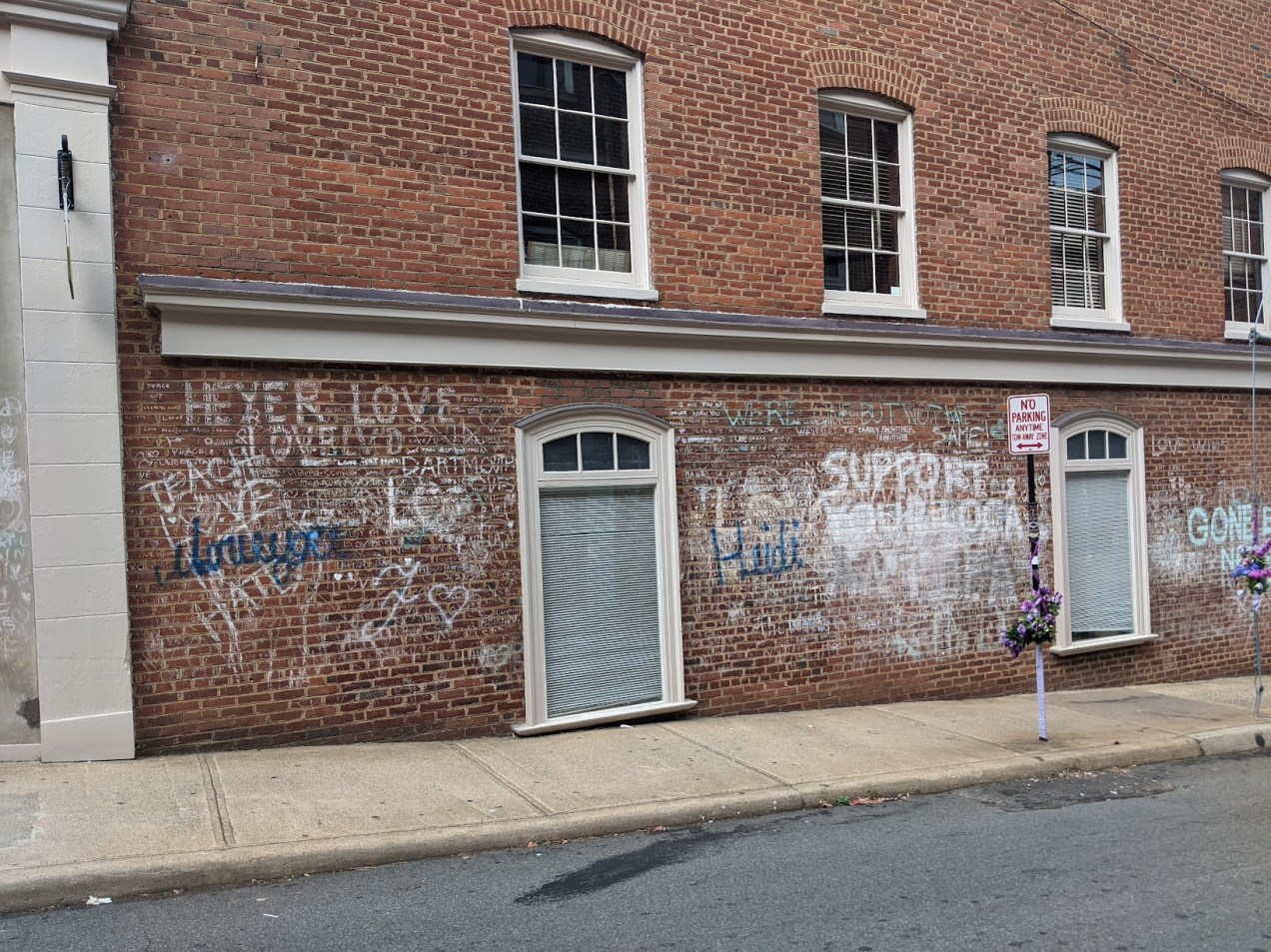
There are still countless chalked and painted messages on the brick walls of businesses and homes, eulogizing Heyer and what she stood for:
“Gone, but not forgotten.”
“Love wins.”
“We are one, but not the same.”
“Love + Action = Change”
“We’ve got to carry each other.”
“I miss you, even though I never met you.”
Cory and I stood in silence and took it all in. We thought about just how tragic Heyer’s loss was, but just how much her passing was able to galvanize the ongoing efforts for peace and unity and this world. We felt due anger at the perpetrator, Fields Jr., and those who radicalized him to be so cruel.
Today, Fields Jr., is in prison, and will be for the rest of his existence. He was given a life sentence, plus 419 years, in July 2019. He pled guilty to 29 of 30 hate crimes to avoid the death penalty outright. His only foray on Earth, too, is over and done, with the same grace of a quick match used to start an arson. He will never be able to serve enough time to restore “justice,” whether or not it can even be offered or considered as equal retribution for what he did. His legacy of hate and his actions of violence qualify no sympathy from me, but even from a Divine perspective, one has to consider just what a waste of a beautiful gift in his own life he ruined, deliberately and at once, when he ruined the lives of so many others.
Ashes to ashes, dust to dust. It’s all a fucking shame.
In my opinion, the best way to honor Heyer’s legacy is to live a life that prevents tragedies like her own: Spread love, not hate. Add a seat to the table instead of being selfish. And take pride in your ability to settle a situation with words before ever seeking to hurt, maim, or kill.
These axioms and mantras, however pleasant they seem, unfortunately get drudged up every few months: We never seem to learn from our own bullshit as a society. Just when we think we’ve seen the worst thing ever, it somehow gets worse. And worse. And so on.
At this point, I basically operate through all my postmodern terror and anxiety with a recurring catchphrase. It may sound cheap, but I like it:
“I could get hit by a bus tomorrow, and that assumes I make it through today.”
That’s just the nature of this life. Some whack-a-doo could put a knife in my neck when I step out of this hotel for dinner tonight. The building itself might collapse. My own heart could betray me with a sudden, fatal stoppage, ending my life at 31. (It happened to my Dad at 46.)
The message is this: Nothing’s guaranteed. Live in the now. Inspire compassion in others, and try to leave the place a little better than you found it.
And, with providence, we will have a society that cries through fewer eulogies and, instead, smiles through more celebrations of life.
###
-moose
PS: Fields Jr.’s attack inspired many other car-ramming attacks against protestors in the United States. Last year, a peaceful protest in my own city saw a woman ram two participants with her car — both of whom I know personally (one as a great friend). Fortunately, they survived with minor injuries. However, the instigator will not see trial: she was found dead in a hotel room earlier this year. Again, we see a scenario where no justice will be served.
It’s easy to say “I hope this never happens in my city.” But it did happen in mine. And there’s a good chance yours could be next, too. This is not to stoke fear or paranoia — just again to remind you of the severity of why it’s important to discuss these horrors and have conversations about how we can heal and recover as a society. These actions are real. And your response matters, now more than ever.
 B-TOWN Moose