
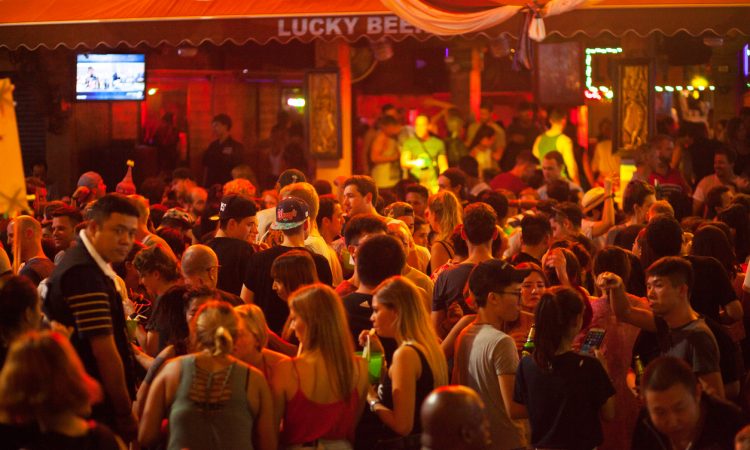
Suppose 100 people walk through your front door tonight.
Hold on, this doesn’t need to be scary. Play along like this brings you joy.
You’ve never met this centurion army of strangers before, but they’re friendly and eager to exchange pleasantries. You share a few drinks and a couple laughs, and you see them out the door with a smile and a wave.
How many of these strangers do you think you could recognize in public again, on your own volition, at any point down the line?
Alas, I’ve hit you with a trick question — each one of them has been inside your living room before, and they’re starting to take it quite personally that you can’t remember them.
This failure, as surprising as it may seem, is the truth behind many (or most) of the interactions I have had as a professional bartender.
Bar patrons give me their time, their attention, and most importantly, their hard-earned money every night I clock in to serve them. Whether they tip or not, my role is to be a soother and a lover. Keep the glasses clean and the pours full. And yet, no matter how hard I try, I inevitably end up disappointing even the most regular of customers.
And so I forget their names. Or their faces. Or that we’ve made a memory together! I sincerely don’t mean it. Who would!? But it happens: There’s just too many personalities on Earth (or a reasonably sized city like “Bloom Vegas”) for a mere mortal 33-year-old like me to remember them all.
There’s a contemporary anthropological theory called “Dunbar’s Number,” first floated in the 1990s, that suggests a primate’s brain size (be it human or ape or otherwise) is directly equal to the amount of social connections it can establish and maintain. Fittingly enough, Dunbar described this upper limit as “the number of people you would not feel embarrassed about joining uninvited for a drink if you happened to bump into them in a bar.”
And as fate would have it, Dunbar suggests this number for humans — across all our family tree branches and work obligations and personal matters and digital connections — is between 100 and 250 separate relationships, and 150 as a general rule of thumb.
Hell, I’m in way too deep to only know 150 people. It seems like a joke in modern examination.
When I graduated from high school in 2009, about 260 people where honored as part of my class. At least 700 in my college’s journalism department turned the tassels with me at Commencement four years later. I have 1,200 “friends” on Facebook, and more than 1,500 followers on Twitter. More than 100 people come into each of my three bar gigs, of which I work five nights a week.
I’m also just now starting my sixth class as an adjunct professor at Indiana University, placing the total number of students I’ve directly mentored at more than 100.
Combine this with the fact I have my own name-heavy social interests — pro wrestling and fantasy football and Ken Burns documentaries and local news and so on — I’m drowning in an ocean of names and faces to remember.
It’s exhausting just to think about, let alone comprehend the scale of.
The numbers don’t lie. And they spell disaster for trying to keep up with every single social connection.
So how are you supposed to reckon with this awkward inevitability — second (or third) introductions followed by a gruff “we’ve met” — in the hospitality industry, an entire field built on making people feel like they’re at home?
Like a pint glass full of backwash, sometimes you have to swallow some pretty awkward situations and ask for more.
A Year of Forgetfulness
Now that I’ve worked in the bar/brewery/nightlife industry for just over 12 months, I feel like I am able to speak with authority on the matter: it is impossible to recognize every single person that comes into your watering hole a second time (or more).
It’s not possible. It’s an ideal, but anyone short of a savant will fail at reaching it.
It’s a truism that I feel can also extend to every public-facing customer service job: retail sales, fine dining, postal services, hair styling, etc. Who among us in any professional format hasn’t resorted to calling a colleague “pal” or “friend,” even if you’ve been introduced several times prior, if only because the weight of your anxiety to get the name right is heavier than our ability to be human (and clearly make a mistake) by flubbing the name?
In my specific instances of weekly work and capitalist survival, I find myself struggling with names and faces across three common Bloomington service establishments — which I have given thinly veiled nicknames in an attempt to separate my online life from my professional alter ego.
That’s rich, I know. But humor me, will you?
Let me introduce you to these venues, and the monikers I call them when speaking into the digital void:
Ye Olde Railway Station
This train-themed brewery gave me my start in the bartending business, where I’ve been tugging tap handles and filling glasses to beer-thirsty and wine-craving patrons off-and-on since early August 2022. The taproom can sit about 200 people at once, per my unofficial estimation, and a lack of formal table service (“order at the bar, sit wherever you want”) can mean scores of additional folks can tuck away into a larger crowd mass on a packed night, such as for college sports gamedays or family reunions or weekly trivia contests.
Lots of people. You get it.
A modern POS (point-of-sale) system requires customers to start a tab with their name and/or a credit card attached. The first go-around of service with John Q. Beerdrinker is pretty easy, as you ask for a form of payment and then the customer is free to take their craft alcohol and enjoy it about the space — you’d be surprised just how subserviently compliant to fulfilling menial tasks that a random person can become with the promise of satisfying beer(s) just moments away, but that’s a blog post for another day.
Where the process of customer service gets difficult is upon their return for a second drink, or even just to close out their bill. When prompted as such, it’s fine to ask “what’s the name on the tab?,” but you can only ask this once without social penalty.
Were you not listening? A second time or more implies that you’re negligent, or not paying attention, or that you’re downright apathetic — even if you have several dozen people in line tapping their foot waiting to get their Happy Hour due, and you’re the only pint-slinger on the clock right now. Not only are you waiting on the person in front of you, but you’re waiting on every single person in the brewery.
The most helpful characteristic to remembering customers in a brewery is that most everyone has their preferred style of beer, and they tend to stick to it religiously. With relative quickness, you begin to create a mental save file for customers who prefer porters, those who prefer amber ales, and so on with sours, lagers, pilsners, IPAs etc.
But alas, the customers’ names are not always there — you have to dig out extra room in your brain to remember them, and you’ve already partitioned off space for valued regulars like Doug and Captain Weaver or the Wilson family.
At some point, the strangers before you might attain such hallowed rank.
But it will likely take a few months, with all honesty.
The Clubhouse
The owner of this basement concert venue graciously reached out to me in after I was temporarily laid off from Ye Olde Railway Station in Winter 2022. My ego was bruised from the incident, but my desire to serve tasty drinks in a trendy environment was just getting kindled.
To understand The Clubhouse is to already be clued into an in-crowd.
The Clubhouse is tucked in a back alley between a gay bar, a Chinese restaurant, and the most heinously fake-friendly parking garage you’ve ever seen. It’s fronted by a plain black door and a hand-painted wall sign. It used to be a place where veterans met for association in the 1970s, but now it’s a kitschy little place to get all Bohemian-chic and do your best Lou Reed impressions on karaoke night.
Specifically, I bartend there on “Honky Tonk Tuesday,” of which I started as a part-time opener. My job was to show up way before the main event and give the A-listers their best chance to steal the show. I roll in about 3 hours before concert time, get the inventory stocked, shoo away a few bugs, make a campy chalkboard invitation street sign, and sell a small handful of draft beers and craft cans in a dusty wooden cubby.
But what initially was a gig keeping the scattershot patrons of Bloomington’s windowless Open Mic Night placated with beers became a more prominent role in the arts community — one I didn’t expect, but fell into my lap more and more as the situation required me to step in and work the concert shift itself.
First came all the musicians, who get two drinks for free. They introduced themselves to me about three times each before I remembered who they were — and more importantly, I had to make sure their beverages were comped by the house. Gratis.
Easier said than done.
I’ve confused the drummer for the singer, the singer for the bass guitarist, the bass guitarist for the acoustic guitarist, the acoustic guitarist for the slide guitarist, and sometimes I just forget some folks like to play the tambourine.
And even though the (nameless) House Band has a rotating cast of dozens, the customer base has an ebbing ocean of hundreds that attends when it can — through work and class and family obligations, they make time for Line Dancing Night, or Queer Tonk, or the much-beloved Ukelele Matinee.
Lo, I forget their names too.
There’s the Asian international student who always gets non-alcoholic IPAs, the tech bro who asks for a Red Bull each week (“we don’t carry those”), and the sweat-stained anarchist who loves our CBD seltzers.
Couldn’t tell you their names for the life of me. Put a knife to my throat, a gun to my stomach, I couldn’t muster them from the depths of hell with a crystal cross.
It’s not personal. I sincerely feel that way.
Each week I triple-check my tab names — Romeweber, Schwartz, Gerson, Gillihan, and so on — but the energy required to keep a small army’s glasses filled drains my ability to identify even the most recognizable faces at the little wooden cubby hole we love.
I started a tradition a few years back where I do something new for my birthday each year, as a little reward to myself. Something to make me feel like I’m still tangibly growing when most days run together like overexposed photographs.
This year, I chose to sing at Honky Tonk Tuesday on my birthday itself. The stars aligned just right, and I took to the stage after my opening bartending shift. I donned a leather cowboy shirt and a straw hat, and tossed Bicycle playing cards into the audience as I sang “The Gambler” by Kenny Rogers.
It was a hoot. Some cuties rooted me on from the front of the stage. And a few strangers even said it was so cool to see me perform “after bartending for so long.”
I just wish I could recall who was telling me such nice things.
The Arcade Bar
Perhaps the least-disguised identity of my three bar employers, The Arcade Bar is the venue where I spend most hours working per week. The Clubhouse’s country music night rarely demands more than 5 hours of my time, and I tend to work for Ye Old Railway Station by picking up open shifts.
The Arcade Bar, however, has taken up about 20 hours of my week, every week, since last Halloween.
I spend a lot of time there! And while I was recently promoted to bartender on Friday nights (some Mondays, too), the mass of my hours amid the video game machines has come as a doorman.
A “door guy.” A “bouncer.” A “hospitality expert.” “Front of house.” Whatever you want to call it.
But whatever you call it, I’m the guy you need to see to get in. The bridge troll you need to pass for free-play Super Nintendo and $5 boozy slushies.
Our establishment is notoriously strict on checking IDs. The rules are simple:
- Everyone must have an ID, and present it
- It must be a valid photo ID within the expiration date
- No exceptions, regardless of age or appearance or convenience
Learning to identify fake IDs with this job has been one of the most fascinating professional positions I’ve held. What at first seemed like spygames or unfathomable tech is actually much closer to spotting knockoff merchandise.
There’s the bad portrait photoshops, the peeling laminate, the dollar-store typeface, the blurry UV highlights, a blown-out “ghost image,” and many more tell-tale signs of a 20-year-old trying paying good money to seem just weeks older than they are. Myriad things I must check just to guestimate — as well as we can under penalty of law — that this person is legally able to purchase a White Claw.
And yet, despite crowd totals of hundreds of guests per night, and parking each new face in front of my door both for examination, and taking their $5 cover and giving them hand-stamps and wishing them well, usually one at a time …
You guessed it. I don’t know who they are.
When you’re checking to see that a certain amount of left-brain information passes the sniff test, it frequently remains separate from the right-brain personality bank that files away each distinct person and personality you encounter.
There was an avid pinball player I used to card every time he came in. This proceeded for months. He grew quite angry that he had to do it every time — and we both knew it was because I couldn’t quite recall if I’ve met him before — and I saved my ass under the guise that “the boss is strict.”
Bullshit. The boss is strict, but about things like drinking on the job or hitting on customers.
I should identify the guy who spends $20 on pinball every week and treat him like a prince.
Alas, I treated him like a social pauper.
There are countless other “pinball guys” that come through my radar without apparent perception on my end. I’ll ask them if they’ve been to The Arcade Bar before and they’ll say I’ve given them the spiel at least 3 times already. I smile with a bashful external grin, knowing all the well that I am internally eating a hot turd with my guilty conscience.
By every metric that matters, I am a good “door guy.” I’m a sharpshooter at picking out fakes, I’ve never lost the door money, and it’s been at least 6 months since somebody puked in the building on my watch.
Those names, though. Those pesky fucking names.
Face the Facts
The best counterargument I have in this monologue on memory is that I’m still beating the numbers.
I confessed to one customer at The Arcade Bar last March that I had trouble remembering who they were, even though they spent hundreds of dollars there on a weekly basis.
“This is your job,” he said with a chuckle. “Shouldn’t you be good at it?”
“That’s the thing,” I replied. “…I am.”
To be a first-world human in the year 2023 is to be inundated with names, faces, celebrities, memes, trends, stories, clips, reels, Tweets, references, viral videos, anecdotes … and so on. There’s no end to the amount of multisensory information that’s launched at our brains without mercy to fatigue or fathomability.
I’m just a guy. A tired 30-something. I can force a smile and tell a joke like nobody’s business, but finding an effective way to store so much raw data about so many strangers eludes me.
In a sense, it’s relieving to know I’m human. To explicitly encounter my limits as a public-facing employee figure. Even if I tried to spread myself thinner and accommodate another new wayfaring stranger’s identity into my brain, I know it would just lead to the dilution and dissemination of people I’ve already met.
In one door, and out the other. Forever and always.
That said, I will never quit this act of trying. Dunbar’s Number be damned! I cannot become complacent. I must do my best to give my best energy each day to widen smiles, improve evenings, and make people feel loved.
Even if I don’t know who they are.
Now if you’ll excuse me, I’ve got 100 (or 150 or 250) strangers at my front door to take care of tonight.
They’re thirsty and chatty, and I’m scheduled to welcome them every Thursday-Friday-Saturday.
Welcome to the bar. I’m so glad you’re here. What can I get you to drink?
###
-moose
 B-TOWN Moose