Now that I’m back home with plenty of time and energy to write again, I’d like to touch upon each of the hotels I stayed at and offer some feedback, in case any of you were considering visiting a city or property I otherwise touched on with my blogging.
The trip wasn’tabout the hotels — they just served as a medium for road-tripping — but I do have some helpful thoughts on each property.
I’d like to go back, in sequential order, and tell you exactly what to look out for, should the fancy strike you to hit the road like I did (assuming life doesn’t shut down again shortly).
Iowa City, Iowa
Crowds gather outside the Graduate Hotel’s public foyer to watch a jazz festival in Iowa City, Iowa.
Say Something Nice: This hotel was hands-down the most accessible to non-guests and the general public. It’s built right along Iowa City’s downtown pedestrian mall, and I was pleasantly surprised to find that the hotel’s outdoor plaza was also a public stage for the weekend’s Jazz Fest. Additionally, the hotel bar (Gene’s, named after a Wilder actor than most) had ample outdoor seating, and a majority of its guests didn’t have a room reservation. I’m not trying to rip too hard on boutique hotels, but a general complaint about them is that they don’t offer a whole lot to folks who aren’t planning on spending hundreds of dollars there — the Iowa City location stands out as a place I’d gladly visit again, even if I were staying at another hotel or a friend’s place some distance away.
Constructive Feedback: Not much comes to mind! I really enjoyed my stay here. Valet parking wasn’t available, but that’s how I prefer my vehicle storage experience: let me do it.Continue reading →
CINCINNATI — Columbus, Ohio, is the city outside of Indiana that I’ve visited the very most, both on this trip and anytime else in my life. I’ve been making the drive across I-70 and back for close to 15 years, seeing friends and spending late nights in anime/arcade game conventions alike.
So in lieu of trying to explore the city like it’s brand-new again, I figured I’d pay tribute to Buckeye Land by adapting one of their traditions as my own. Continue reading →
COLUMBUS, Ohio — From the very minute I booked my stay in Charlottesville, Va., I knew exactly where I would eventually end up.
These days, the tragedy is synonymous with “Charlottesville” itself, much like “Waco” or “Oklahoma City.”
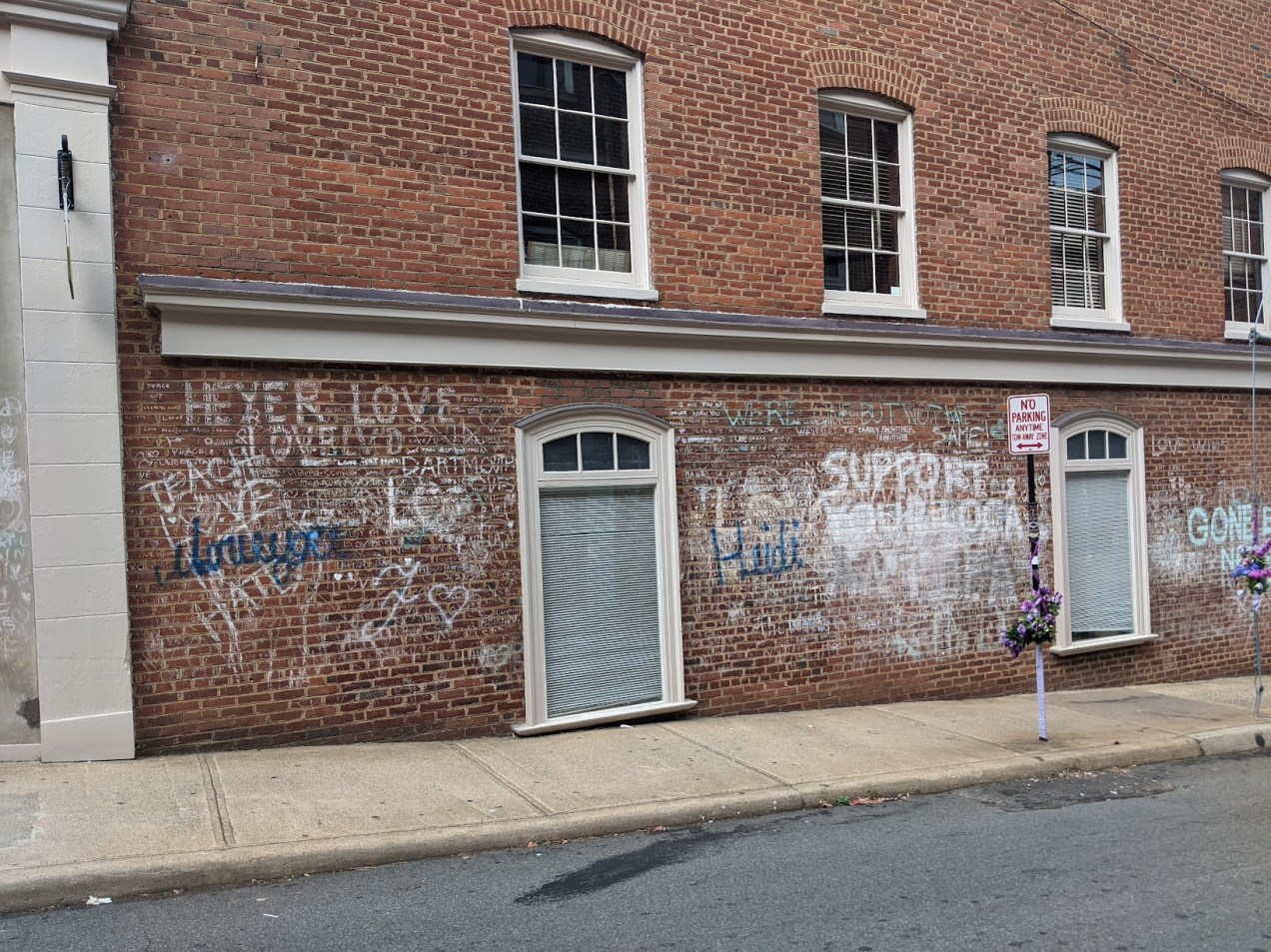
On August 12, 2017, James Fields Jr. drove his car into a crowd of people counter-protesting the “Unite the Right” white supremacist rally near Charlottesville’s historic pedestrian mall.
His 2010 Dodge Challenger rammed a mass of human flesh, tossing several dozen bodies in the air. In addition to terrorizing millions of people around the world who felt compelled to stand up for justice, he injured 35 peaceful pedestrians, and brutally murdered an innocent woman: Heather Heyer, who was hesitant to even attend the protest, but decided to join last-minute because the cause was too important to not show up for. Continue reading →
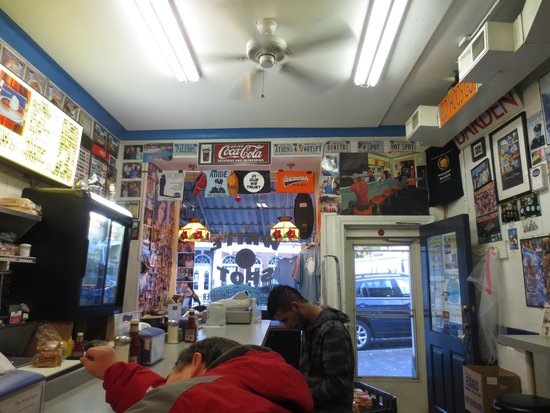
COLUMBUS, Ohio — If you find yourself at the corner of the University of Virginia campus and the UVA Hospital, be sure to tuck under the elevated railroad tracks at 14th and Main streets and check out a little hole-in-the-wall burger joint called “The White Spot.”
Go ahead and take your best guess as to why it’s called The White Spot. You won’t figure it out.
Okay, ready? (Sorry to patronize you. Let’s go.)
The “White Spot,” seen lower left, represents the former barbershop history of an esteemed local restaurant in its own right, on July 26 in Charlottesville, Va.
The White Spot, which has been in operation as a diner for more than 65 years (according to my amateur internet sleuthing) used to be a single-chair barber shop in the good old days. Whenever the central hair-cutting seat was removed, it left a neat, 2-foot-wide round spot in the old-school tile. Instead of filling in the gap with calculus and laborious ceramic measurements, the owners covered it with a smooth cap of white paint and went right to work making burgers.
Today, the “White Spot” is still available to stand on, walk over, check your phone by, and generally bide your time next to as you ponder the litany of cheap eats the restaurant provides students and locals alike at 1407 University Avenue (between its modern neighbors, a smoothie bar and a poke/sushi joint).
Regardless of its cosmopolitan, worldly surroundings, The White Spot is the sort of place without a website or a brand page. They don’t have time for that. They’re busy taking orders.
My buddy Cory, who lives in Washington, D.C., made the 2.5-hour jaunt over to Charlottesville, Va., to hang out with me for two days, and he and I both agree that our best meal in town came from The White Spot, a burger joint/diner haven that seems to exist decades beyond its expected lifespan.
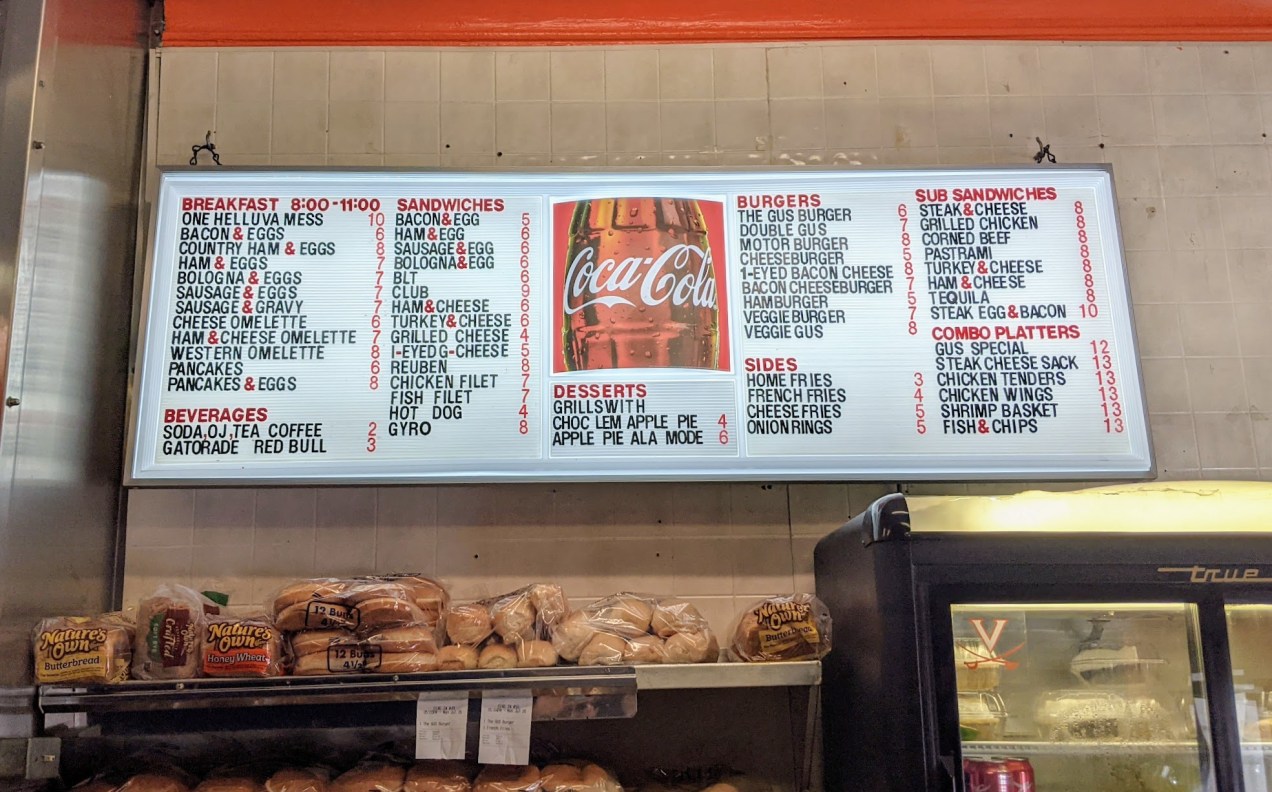
Take a look at the White Spot’s menu and you’ll notice a few things: It’s on an old-fashioned letter pegboard, with every single menu option spelled out. That same food list hangs across the restaurant three times (twice for indoor customers, once in the window for passers-by). All of the options end in exact dollar totals. And there’s enough room for all of your (new and old) favorites, whether its a hot dog ($4), a Gus Burger ($6), or the “One Helluva Mess” breakfast tray ($10).
And if you’re feeling something more elegant? Try “The Grillswith,” two fried, classic Krispy Kreme donuts with a scoop of vanilla ice cream in between.
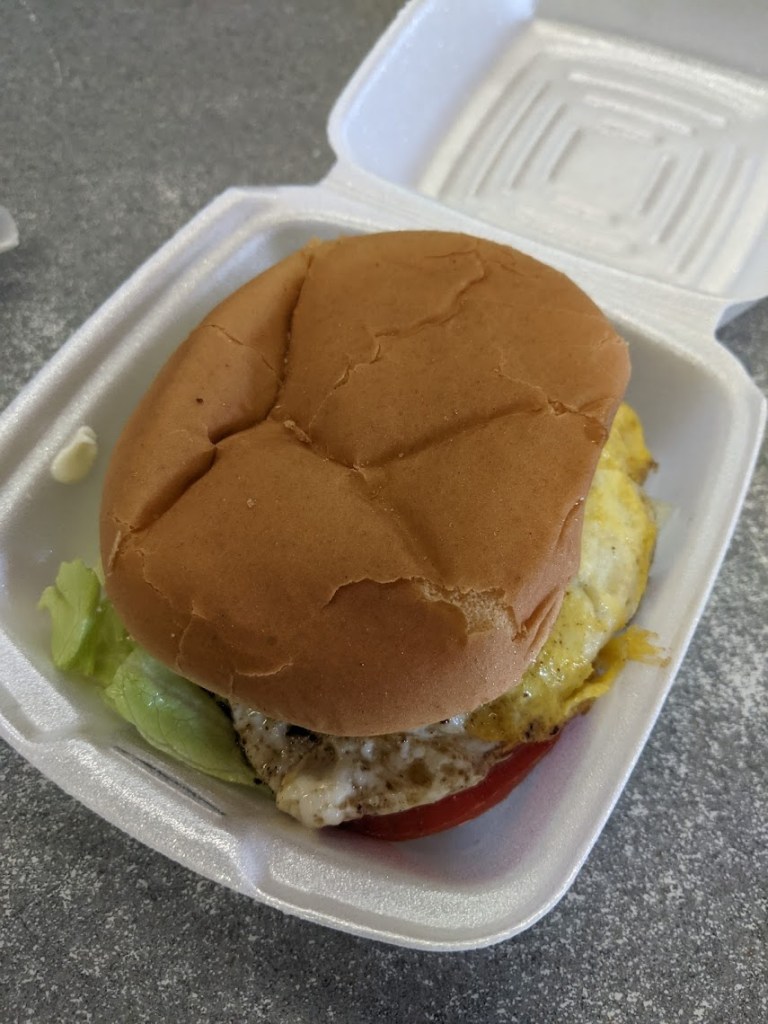
Cory and I dropped by for dinner on Monday night and each decided on the signature Gus Burger, which is a traditional American cheeseburger (your choice of toppings) with a fried egg on top. I ordered first and the chef/cashier went right to work, cracking a raw egg on the griddle flat and placing a patty nearby before ringing me up. I winced at first, thinking that my order would have displaced Cory’s meal by 10 minutes or so, but our man behind the counter had this all down to a science. Cory placed his order soon after, the chef flipped my burger and mashed my egg, and got right to work getting Cory’s meal on the burner.
We each waited about 3 minutes — raw to ready — and both our burgers were primed for immediate consumption.
My “Gus Burger,” as ordered with lettuce, tomato, and mayo, on July 26 in Charlottesville, Va.
The White Spot’s burger patty is skinny, but so satisfying. The meat was hot and sizzling, and the bun was fresh. The egg was mixed around just enough to keep from spilling into (and out of) our mouths. I ordered mine with lettuce, tomato, and mayo, like I do most any other burger, and had to pace myself from murdering the delicacy in less than 90 seconds.
Cory got fries with his from the get-go, which he artfully laced ketchup over, and I placed a second order so I could try their onion rings, which were fried in a basket in front of me and served piping-hot in a waxy paper boat. The rings were thin, and I normally prefer mine to be meaty and heavy on the onion side, but these were crispy and tasty, and the flavor stayed with my mouth for hours.
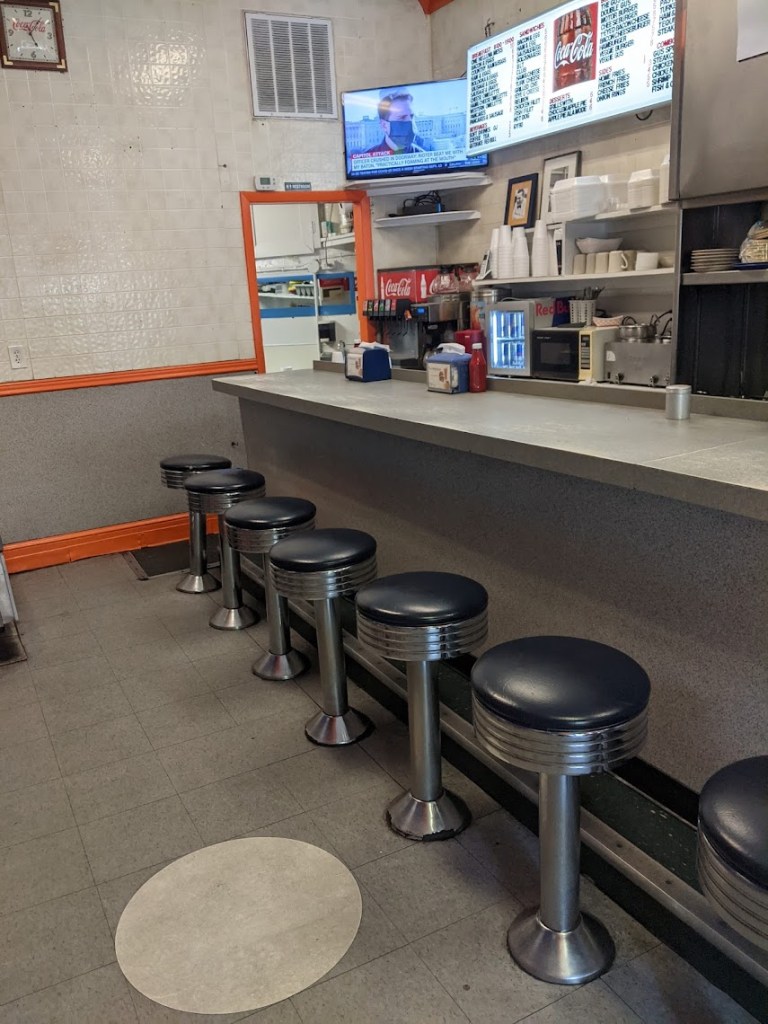
The White Spot, apparently, is a favorite of locals near the UVA campus. Three students were enjoying their meal outside (somehow, in the humid 100-degree heat index) while Cory and I sweated it out at the counter inside, which he said reminded him of the southern sit-in boycotts of the Civil Rights Era — the kind of establishments with round, steel stools with a mild vinyl padding, and a linoleum eating surface that spans the length of the eatery. Mentally, you could place it among collective cultural visions of early-stage McDonald’s, or what (the currently flailing and failing) Steak & Shake wanted you to believe they were all along.
Cory and I each agreed that the food was incredible on its own regard, and it was refreshing to see it rang up, cooked, and served by a one-man crew. He personally thanked us for coming in and threw our trash away, too.
But the price blew us away the most. College town prices can come at a premium (a six-pack of Bud Light at the corner mart down the block came to $12, for instance), but paying $6 for a burger with an egg and cheese, served faster than your favorite punk rock song, could not be beat at any cost.
In fact, Cory went back the next morning for a breakfast sandwich before hitting the road back home to our nation’s capital. He crushed it in our eighth-floor hotel room as I was busy trying to find jeans and make something of my Tuesday morning.
Again, if you ever find yourself in Charlottesville, you’d be doing yourself a disservice to not drop by the White Spot. We went by on a Monday afternoon and felt like we had a prolonged handshake with the local secret. We can only imagine what it’d be like to see the place at full-capacity after a UVA football or basketball victory on a weekend evening. Drop a $10 bill and treat yourself to some bona fide quality greasy-spoon cooking.
You won’t regret it. Look for it by name — circle marks the spot.
###
-moose
An undated photo of The White Spot burger joint in Charlottesville, Va. (Google Photo)
CHARLOTTESVILLE, Va. — On Friday night, I was given a local’s tour of the city by a good-natured Virginian.
My buddy David, who I grew to chat with more and more during the pandemic, is an adjunct instructor (like me!) at Virginia Commonwealth University, just about a few blocks from where I was staying in downtown Richmond.
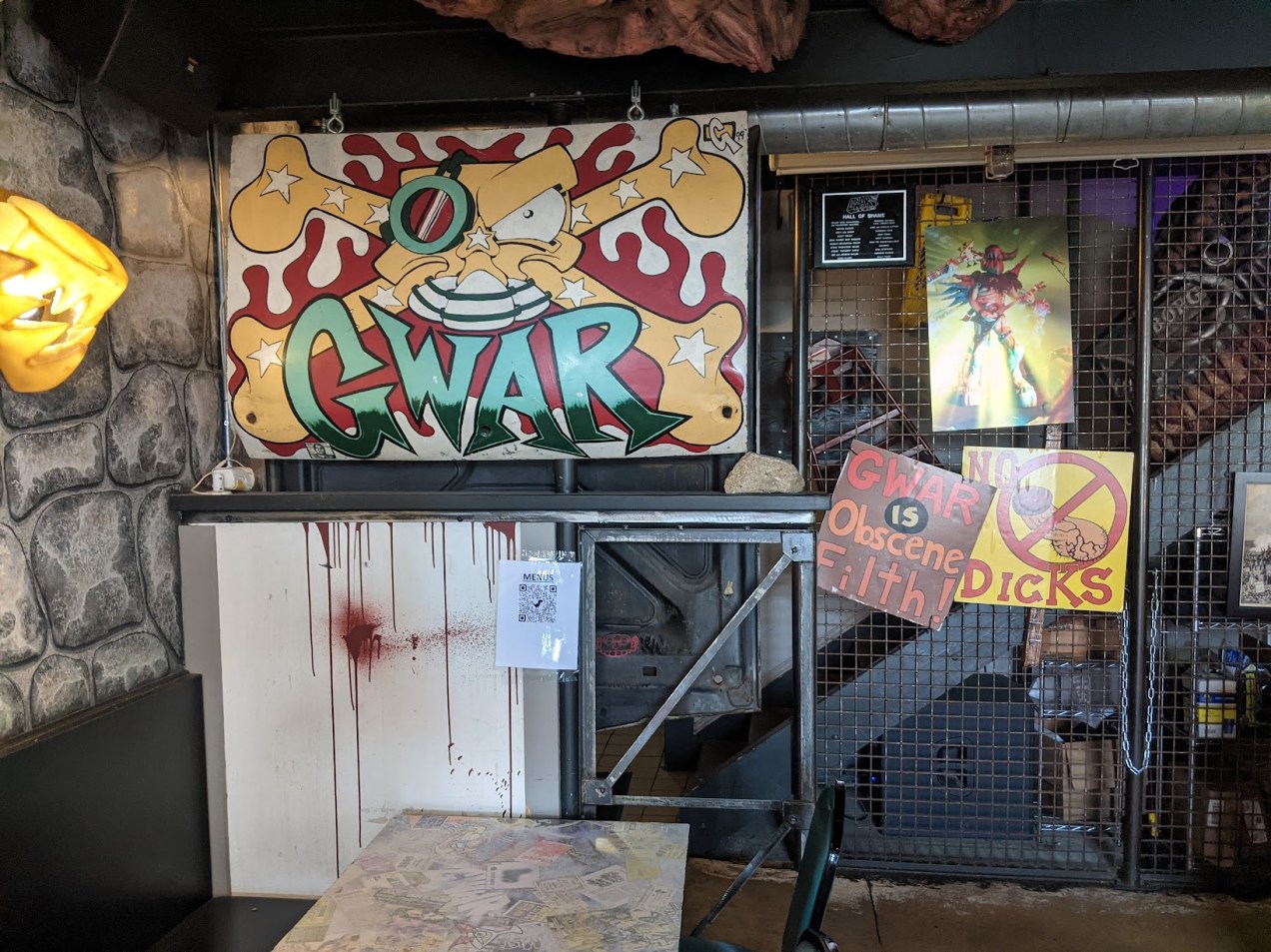
He picked me up for a quick bar crawl (“beer crawl?” is that a thing?) around the “RVA” area, including a place I’ve had on my radar for a little bit now — and if you’re kind of a freak like me, maybe you’ll relate:
GWARBar
It’s not every day that you find yourself in a city with a tavern named for the local heavy metal band with giant phallic costumes and stage names like Flattus Maximus, Beefcake the Mighty, and Nippleus Erectus. Continue reading →
Much like my experiences in Columbia, S.C., showed me, Richmond is a city that has long had to reckon with its own heroes, especially with a past rooted in the Confederacy.
Perhaps “rooted” isn’t strong enough: This place was the literal capital of the Confederacy (moved from Montgomery, Ala., in 1861 with the strategic intent to use its iron resources and naval access). Today, and since 1890, Richmond’s Monument Avenue pays tribute to the figures (“heroes,” to some) who inspired and instigated Dixieland’s most infamous cause.
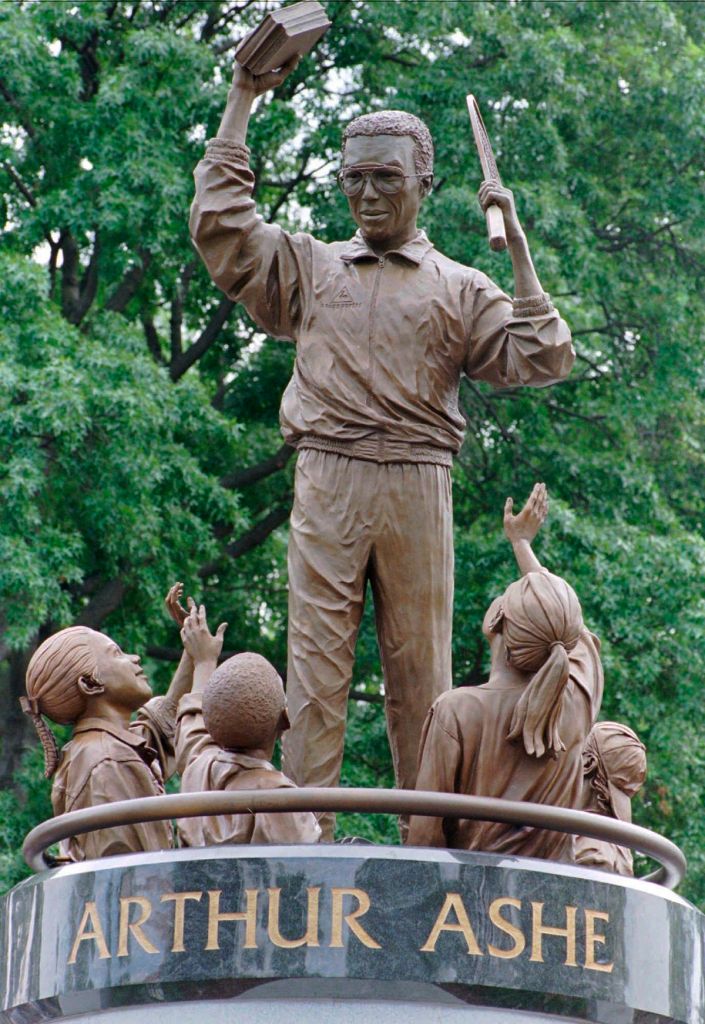
But one face in particular stands out from the crowd: Tennis legend Arthur Ashe, a black athlete and Richmond native who was excluded from many facilities (let alone tournaments) because of his race — before winning 3 major titles and becoming a pre-eminent face of representation and humanitarianism in the modern era.
But in February 1993, Ashe died of complications stemming from HIV, which he had battled privately for nearly 10 years. Doctors speculate that his diagnosis started around 1983, when Ashe’s second heart surgery (a corrective procedure) used an HIV-infected blood transfusion. News of Ashe’s diagnosis only became public in June 1992 when a personal friend who worked for USA Today called to verify if Ashe was as sick as the rumors suggested.
Ashe, refusing to appear weak, opted to break the news on his own in a public statement.
He died 10 months later, finishing his three-part book series on the history of the African-American athlete less than one week before succumbing to pneumonia, which he called a bigger achievement than any tennis win.
Arthur Ashe’s statue stands on Monument Avenue in Richmond, Va. (Wikipedia photo.)
While the Confederate heroes on Monument Avenue stand poised, proud, valorous, etc., Ashe’s statue was added to the western end of the row in 1995, two years after his death, as he chose to be depicted: Suffering, gaunt, and dying. His bones are frail and his skin is tight. His clothes hang off of his wiry frame in the statue. He’s holding books and his beloved tennis racket, and he’s speaking to young children — extoling the virtues of intelligence and sportsmanship alike.
The addition of Ashe’s statue, of course, ruffled the feathers of “traditionalists” who did not want the sanctity of their slaveowners tarnished with…you know…a black guy who actually grew up here and did more for progress in his storied lifetime than they ever could hope for in 4 futile years.
But if you ask me what’s more inspiring: A bunch of fogey old white dudes who killed thousands of their brothers so they could own black men? Or an intelligent, stoic, well-written black man who died courageously, privately, as the whole world watched him struggle — afraid to appear either weak, or, stereotyped with a “gay man’s disease?”
That’s not even a debate in my book.
Recently, Richmond has continued the process of re-writing its history with a contemporary rhetorical response to what “heroes” mean today:
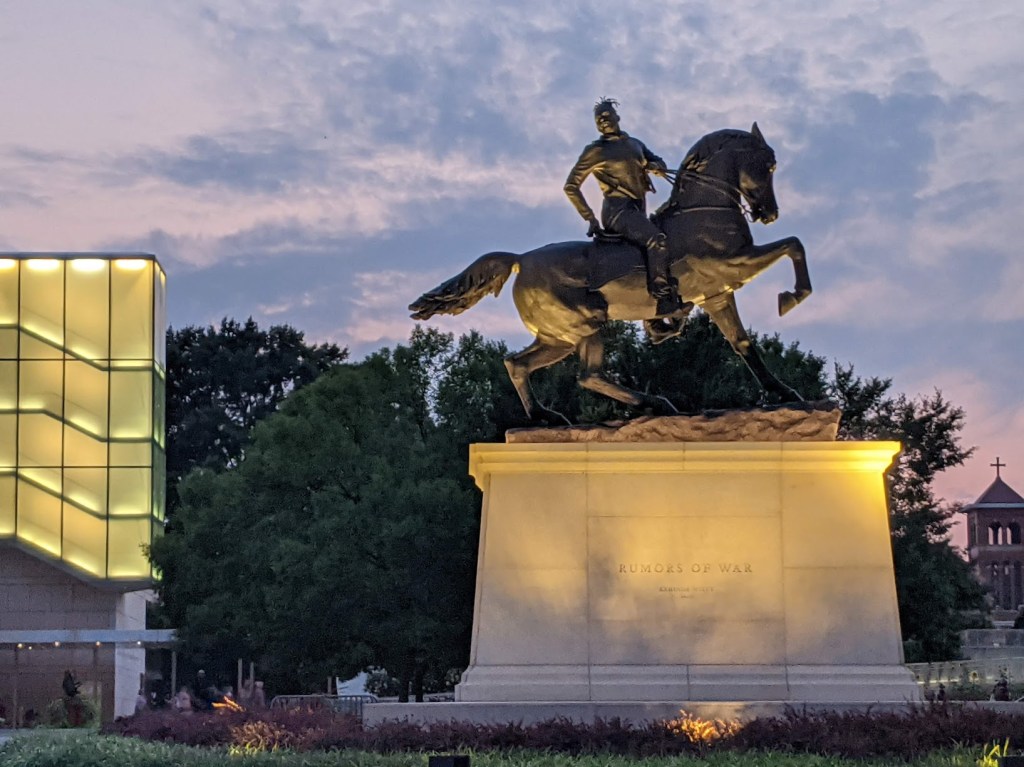
In 2019, the city unveiled “Rumors of War,” a massive bronze statue of a modern black man (with dreadlocks and a hoodie) riding a horse, directly echoing and responding to the row of Confederate statues on their equine mounts. The sculpture by Kehinde Wiley (known for his famous official presidential portrait of Barack Obama) was originally debuted at Times Square in New York City, and thousands of Richmond citizens assembled to welcome the new piece on the grounds of the Virginia Museum of Fine Arts.
“Rumors of War,” as it stands on the grounds of the Virginia Museum of Fine Arts on July 23 in Richmond, Va.
Wiley said he was directly inspired to create the statue after visiting Richmond in 2016 and seeing J.E.B. Stuart’s horse-centric statue, and thusly modeled Rumors of War as a parallel response to it. Today, it sits on Arthur Ashe Boulevard, just a few blocks away from Monument Avenue.
At its unveiling, Virginia Gov. Ralph Northam (who had a high-profile blackface scandal in 2019) said that “people in Richmond will recognize its shape and its form, but it depicts a person who looks different from every other statue in this city — and there are a lot of them. … And so today, we say welcome to a progressive and inclusive Virginia.”
Wiley himself said it in a more blunt way: “It’s a story about America 2.0.”
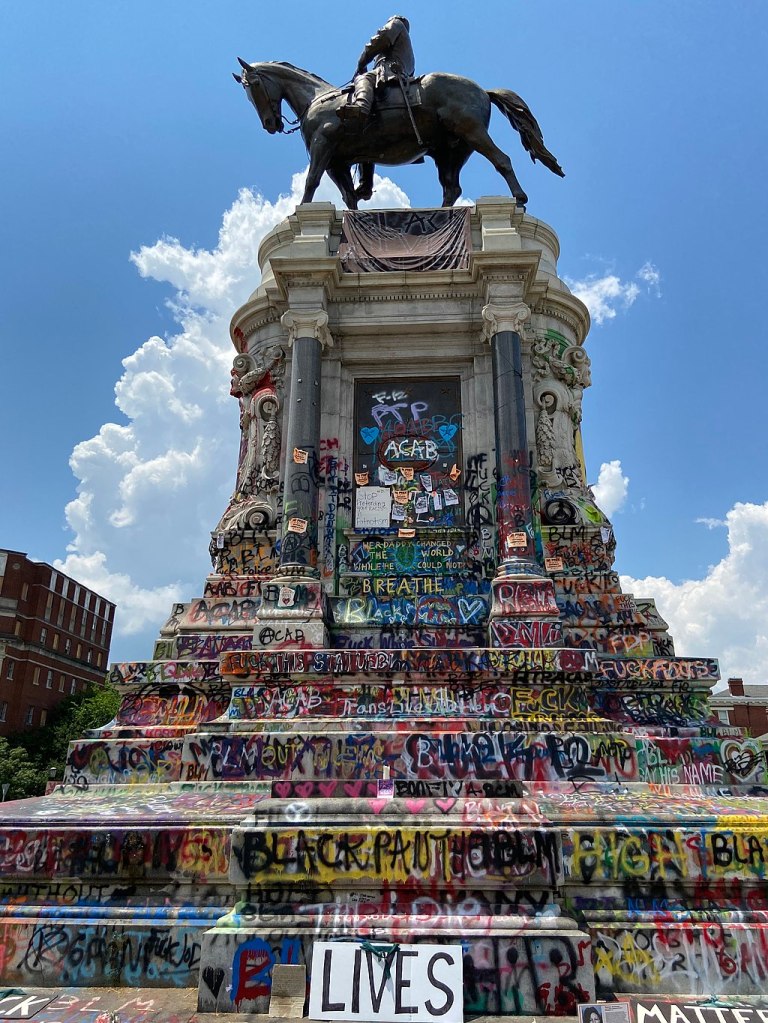
The monument statue of Robert E. Lee in Richmond, Va., days after the protests following George Floyd’s death in 2020. (Wikipedia photo)
But of course, Richmond’s rhetoric when it comes to racial discourse and heroes has not always come with a ribbon-cutting or a statue reveal: After a 2017 “Unite the Right” rally in Charlottesville, Va., turned deadly — as well as the police murder of George Floyd on May 25, 2020 — the Lee monument was covered in graffiti, and many activists called for its outright removal. In October of last year, the New York Times deemed this public reaction “the most influential American protest art since World War II.“
In June 2020, the Lee Monument was unofficially repurposed with a citizen sign: “Welcome to Beautiful Marcus-David Peters Circle, Liberated by the People MMXX,” memorializing Marcus-David Peters, a Black man from Richmond who was shot and killed by the police in 2018. The area contained signs that told the story of Peters and lifetime/societal milestones he has missed since his death. The location is frequently used as a common protest site to remember all who have died from police brutality.
Today, the Lee monument sits behind heavy blockades (erected January 2021) to prevent more public defacing as the statue’s fate remains in question.
So what’s the fate of the Robert E. Lee statue? Well…
(Warning! Legalese ahead: Gov. Northam himself ordered the statue removed on June 4, 2020, but a state court blocked its removal pending the outcome of a lawsuit. The state court ultimately ruled in Northam’s favor in October 2020, but the decision was put on hold pending appeal. The Supreme Court of Virginia heard oral arguments on June 8, 2021. The Justices did not ask any questions during the oral argument. The Lee statue remains intact at this time, but the Lee statue in Charlottesville, Va., was removed about 10 days ago.)
In addition to what I’ve said about Arthur Ashe and “Rumors of War,” here are some other key events in Richmond’s storied history of racial reckoning:
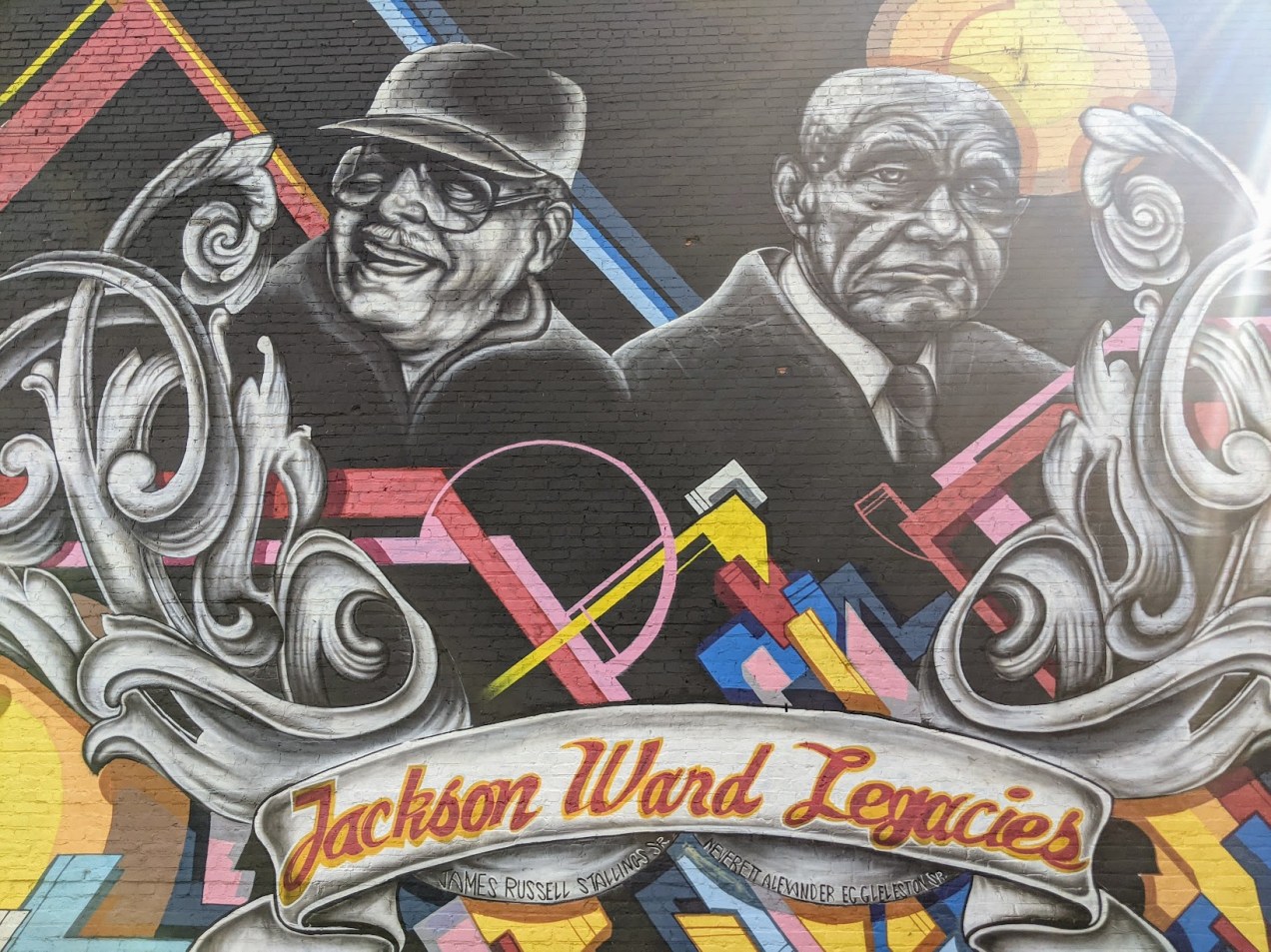
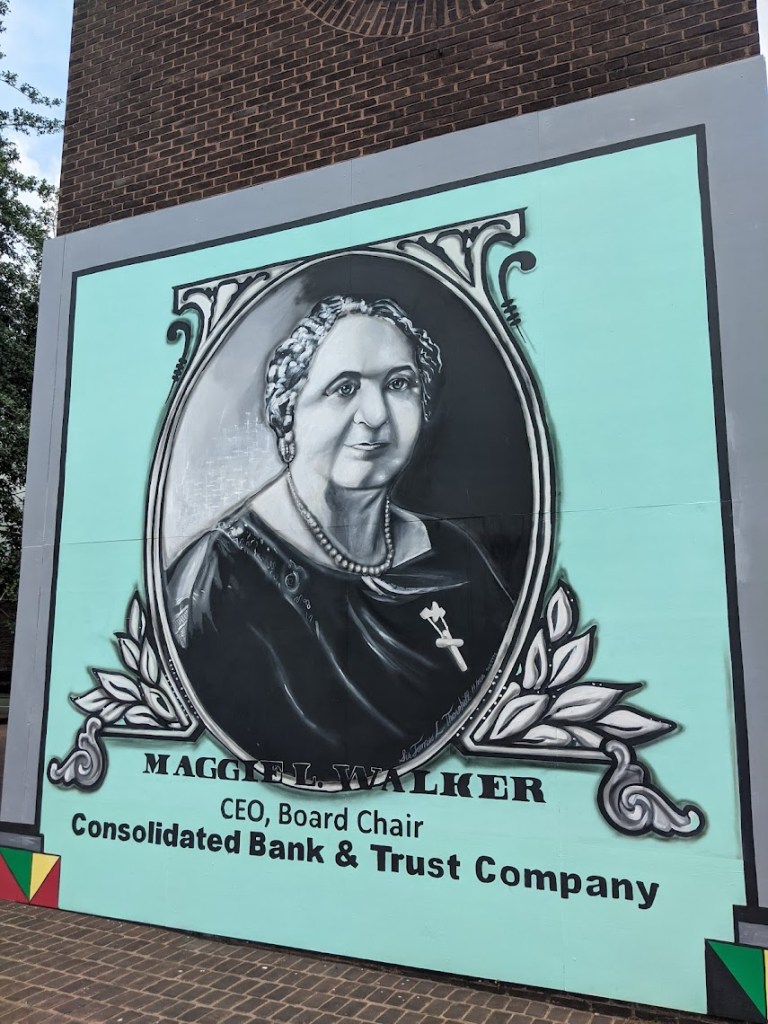
A mural of Maggie L. Walker stands in Jackson Ward, a predominantly black historic neighborhood in Richmond, Va, outside the bank she founded in 1903.
In 1903, African-American businesswoman and financier Maggie L. Walker chartered the St. Luke Penny Savings Bank, and served as its first president, as well as the first female (of any race) bank president in the United States. Today, the bank is called the Consolidated Bank and Trust Company, and it is the oldest surviving African-American bank in the U.S.
In the first half of the 20th Century, Richmond native Bill “Bojangles” Robinson became the best-known and highest-paid African-American entertainer of the United States. Throughout his career, he used his fame to lobby presidents for more equitable treatment of black men in the military, founded the New York Black Yankees baseball team, and became the first black performer to appear in an interracial movie dance scene (with Shirley Temple in “The Little Colonel,” 1935).
The last thing I want this blog to become (though I would rest easy with the fate, should I get struck by a bus tomorrow) is a constant barrage of anti-Confederate thinkpieces — truthfully, there’s not much to think about — but that’s a hard fact I’ve learned during my first times in South Carolina and Virginia, respectively. I’m sure that the folks who live here would rather not have to think about the ugly truths of these men, either, but they’re plastered on nearly every corner as “heroes.”
But as I said in my post about Columbia, it is not just the right thing to do, but God’s Will, to continue to learn from our atrocities as people and ensure that our peers are treated with the dignity and respect they deserve, both in the now and in the future.
Richmond is a lovely place. It’s a poor place. It’s an opulent place. It’s a fatigued place. It’s a historic place with a rich arts culture. It still has much work to do in terms of figuring out how it represents its own legacy going forward.
But all of that is true about the United States at large — and I was privileged to spend this weekend visiting a distinctly American city.
And a city of heroes, at that.
###
-moose
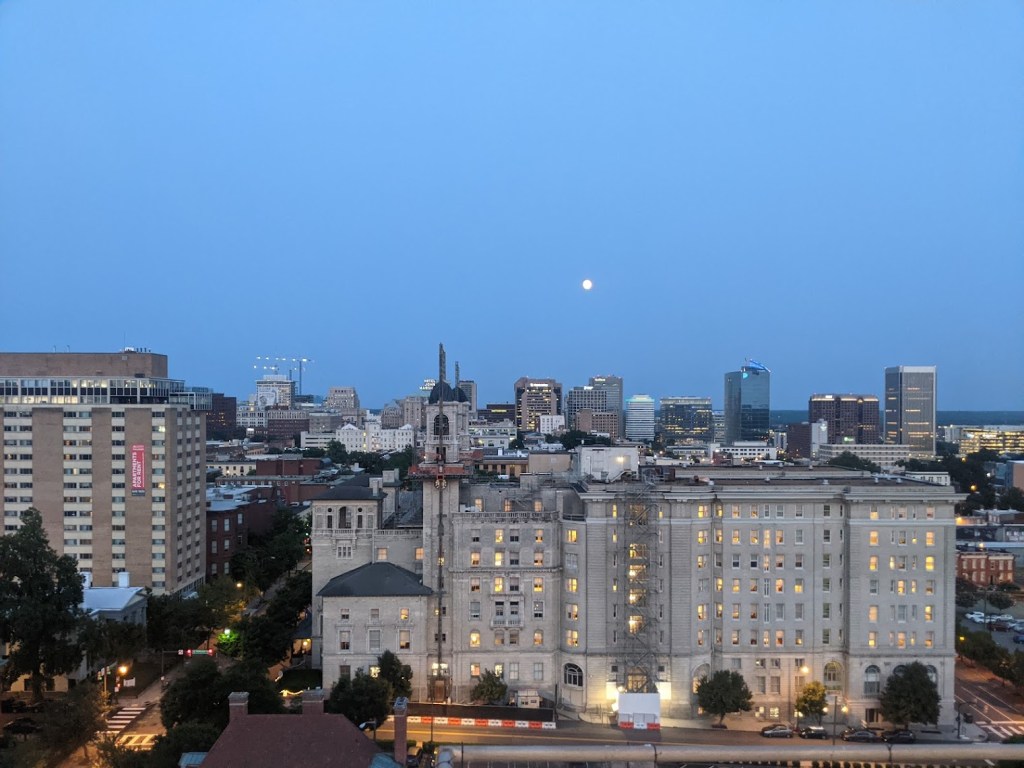
A full moon rises over downtown Richmond, Va. on July 22.
RICHMOND, Va. — It’s been a minute since I put pen to paper (or fingers to keys) to share about my travels, so I hope you will forgive my delay in writing about Chapel Hill — I needed a few extra days to comprehend it.
You’d figure that a place that fostered both the greatest men’s basketball player of the 20th century (if not ever) and the most influential U.S. women’s soccer player of all time would be a major city, but alas, Chapel Hill is close to 275 years old, and still only has about 50,000 residents within its borders. It’s the 15th-smallest city in North Carolina, and measures about 20 square miles.
CHAPEL HILL, N.C. — Now that I’ve made my peace with Columbia, S.C.’s 19th Century history, I wanted to say a few kind and redeeming things about the stay — because the two days I had there were genuinely a sweet and charming time.
When I rolled into Columbia, I knew jack-nothing of its history. Zip-zilch-nada. Just that the sports teams are called the Cocks. (Short for “Gamecocks.”)
Fortunately, the locals made sure I learned about a certain, less-suggestive pride point:
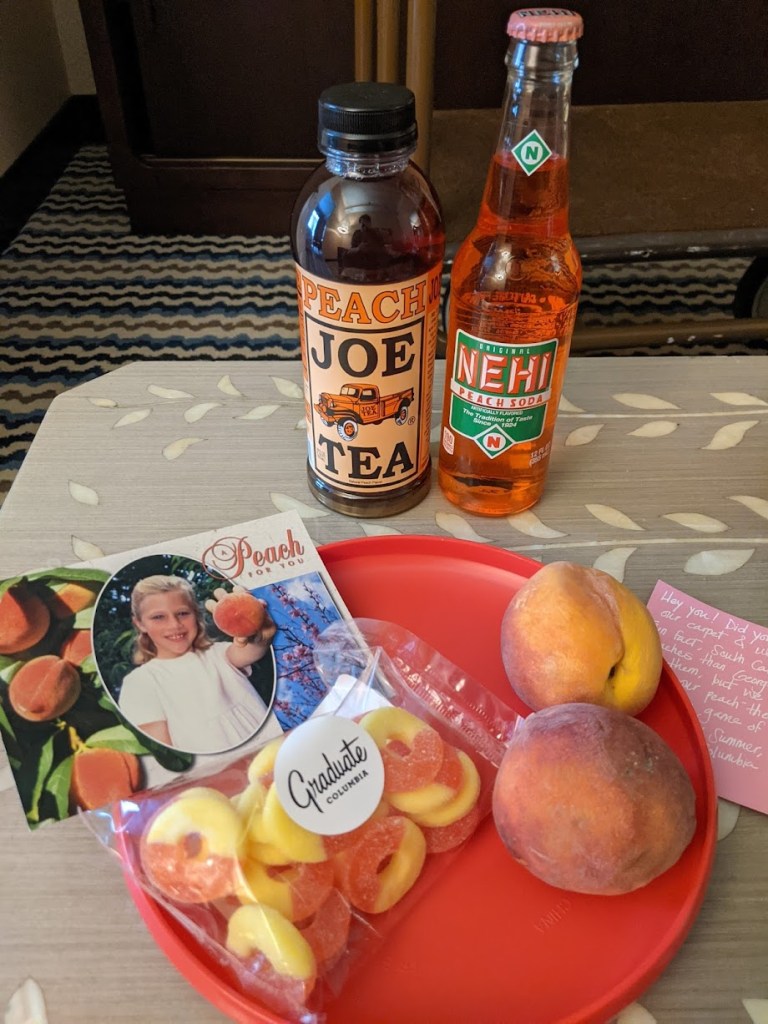
A peachy-keen little gift package left for me in Room 318 of the Graduate Hotel in Columbia, S.C.
“Did you know South Carolina produces more peaches than all of Georgia?” a personalized, white-on-pink note in my room read. Continue reading →
COLUMBIA, S.C. — I’m having a really hard time finding the words I want to say about Columbia.
So let’s jump right into it:
Columbia, South Carolina, was the early heart of the Confederacy — a period of American history (or treason) I look back on with much contempt. Continue reading →
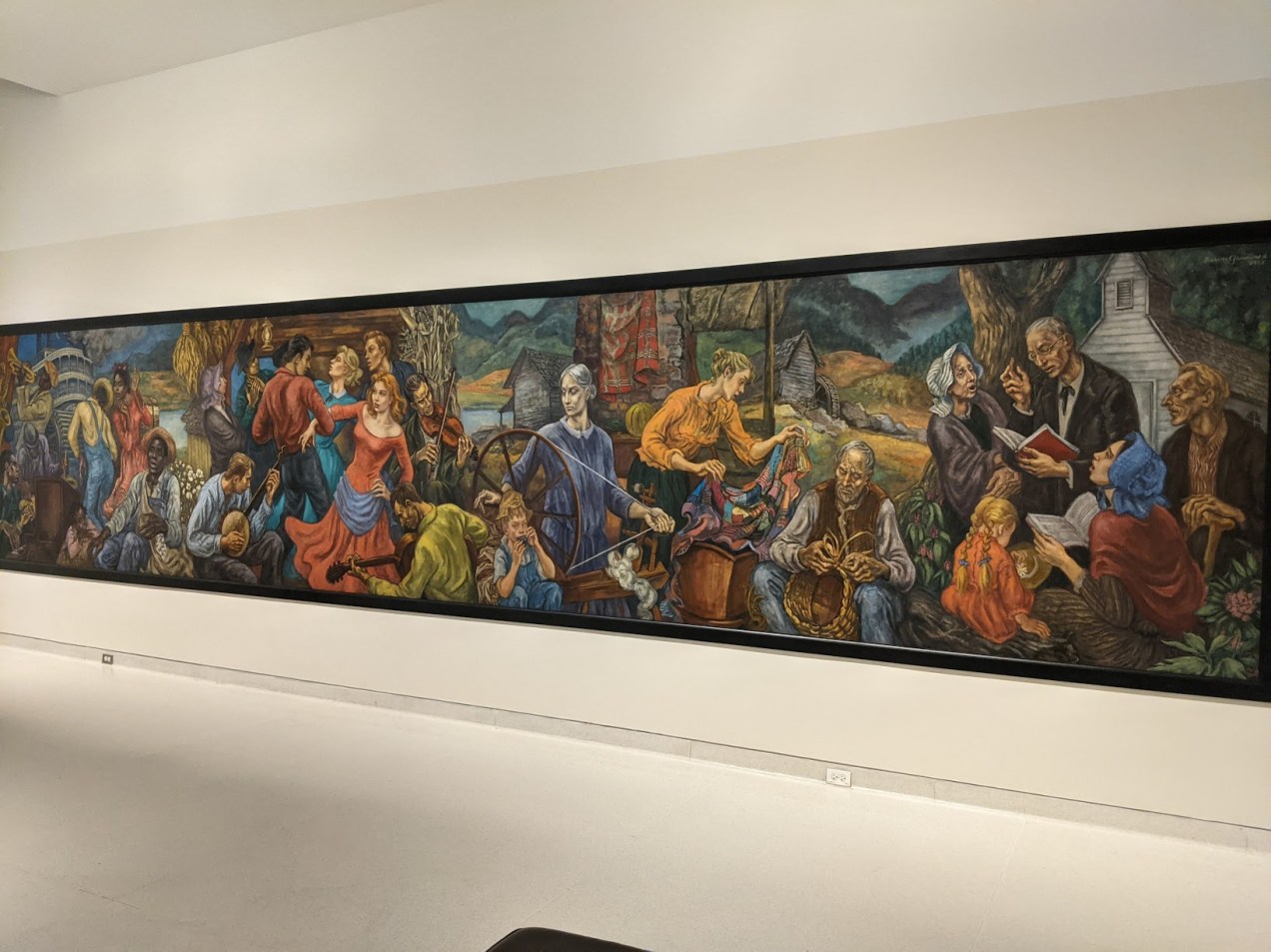
Photo Caption: Marion Greenwood’s “The History of Tennessee” mural hangs in the Knoxville Museum of Art on Saturday, July 17. The painting has been a flashpoint of conversation and controversy as to the depiction of African Americans and their contributions to Tennessee history.
COLUMBIA, S.C. — Before I get started with this next post, I want to give a sincere thank-you to everyone who’s still reading along here and following my road trip.
I get that, with me writing a big post nearly every day, it’s a lot to follow. That’s the other side of me bragging about nearing 30,000 words — inevitably, the more I write, the harder it’s going to be for people to catch up. (Even my best friends are a few posts behind.)
So thanks for the support. I’m feeling a bit discouraged this Monday morning as the view count has steadily dropped, and my energy has been harder to find as I near Week 4 of the journey.
But I have to remember that I’m here to write for me, and that’s what I’m going to keep doing — I appreciate anyone who still makes time in their daily lives to make room for my drivel.
Bloomington and Knoxville: Long-lost Cousins?
I couldn’t help but draw parallels between Knoxville, Tenn., and my hometown of Bloomington, Ind. Continue reading →




 B-TOWN Moose